Slay the Spire
- 4.3
- Rating
- 1.00M
- Installs
- $9.99
- Price

 Analysis by App-foxy
I went into Slay the Spire expecting a straightforward card game and quickly found something more demanding: every battle is also a decision about the shape of my future deck. Balor Games presents it as a deckbuilding dungeon crawl, but that short description misses the real appeal. The game is about managing risk, recognizing when a tempting card is actually harmful, and recovering from a run that looked promising a few rooms earlier.
This is a premium card game for Android, priced at $9.99, with an Everyone 10+ age rating. It has reached over one million installs and holds a 4.3 average from around thirty thousand ratings, which matches my impression that it has found a strong audience among players who want something deeper than a quick solitaire-style session. It was released on January 22, 2021, and the current version is 2.6.1, with Android 5.1 or later required.
What makes the first run harder than it looks
The opening battles are easy enough to understand, but the game starts asking difficult questions almost immediately. Should I add another attack because it helps right now, or keep the deck lean so that defensive cards appear more reliably later? Is a risky route worth taking for a better reward? Do I spend a valuable resource before a difficult encounter, or save it for a fight that may never arrive?
You May Also Like

 Blood Strike: 2.5 Anniversary
Blood Strike’s Loadouts Turn Every Drop Into a Tactical Gamble
A close look at Blood Strike’s custom loadouts: how fast access to signature weapons reshapes its battle royale rhythm, rewards preparation, and narrows the gap between fights.

 Pandora - Music & Podcasts
Pandora’s Music Is Easy to Start, but Harder to Recover
Pandora’s strength is its low-effort path from a seed to a station. Its weak spot is how much confidence it asks you to place in connection, setup, and quiet recovery.

 8 Ball Pool
 Is Built on Rivalries, Rematches, and Routine
A close look at the rivalries, rematches, shared routines, and unanswered safety questions that turn a quick pool match into a persistent mobile community.

 Samsung Music
’s Quiet Strength Is Playing What You Already Own
Its reach comes less from spectacle than from dependable access to a personal library. That simplicity is both the app’s strongest retention engine and its ceiling.

 AccuWeather: Weather Radar
AccuWeather Review: A Quick, Clear Forecast for Everyday Decisions
For everyday plans, the best forecast is the one you can understand quickly. AccuWeather makes rain timing, radar, and local conditions easy to act on, with a few trade-offs.

 Hill Climb Racing
Why Hill Climb Racing Still Turns Crashes Into One More Run
A tiny car, a bumpy hill and one more upgrade: Hill Climb Racing keeps resurfacing because its simple chaos makes every near-miss feel personal.
More From Our News Desk
View All News


That tension is the heart of the experience. A new player can win several encounters while still building an awkward deck, then suddenly discover that the cards no longer work well together. The problem is rarely a single bad draw. More often, I have accepted too many cards that seemed useful individually and created a deck that is slow, unfocused, or unable to defend consistently.
The map is where many users get stuck without realizing it. Choosing the next room is not just a matter of taking the shortest path. I look ahead for a balance of ordinary fights, events, rest opportunities, and tougher encounters. A route with more rewards can also leave the character worn down before an important battle. When I am learning an unfamiliar character, I prefer a safer route and use it to understand the deck before chasing ambitious combinations.
Another early stumbling block is treating every card reward as a prize that must be collected. In this game, skipping a reward is often the better move. A card that does not support the deck's current plan increases the chance of drawing something unhelpful later. That is one of the most valuable habits I learned: a smaller, coherent deck is frequently stronger than a large pile of individually attractive cards.
Reading the battle screen instead of reacting to it
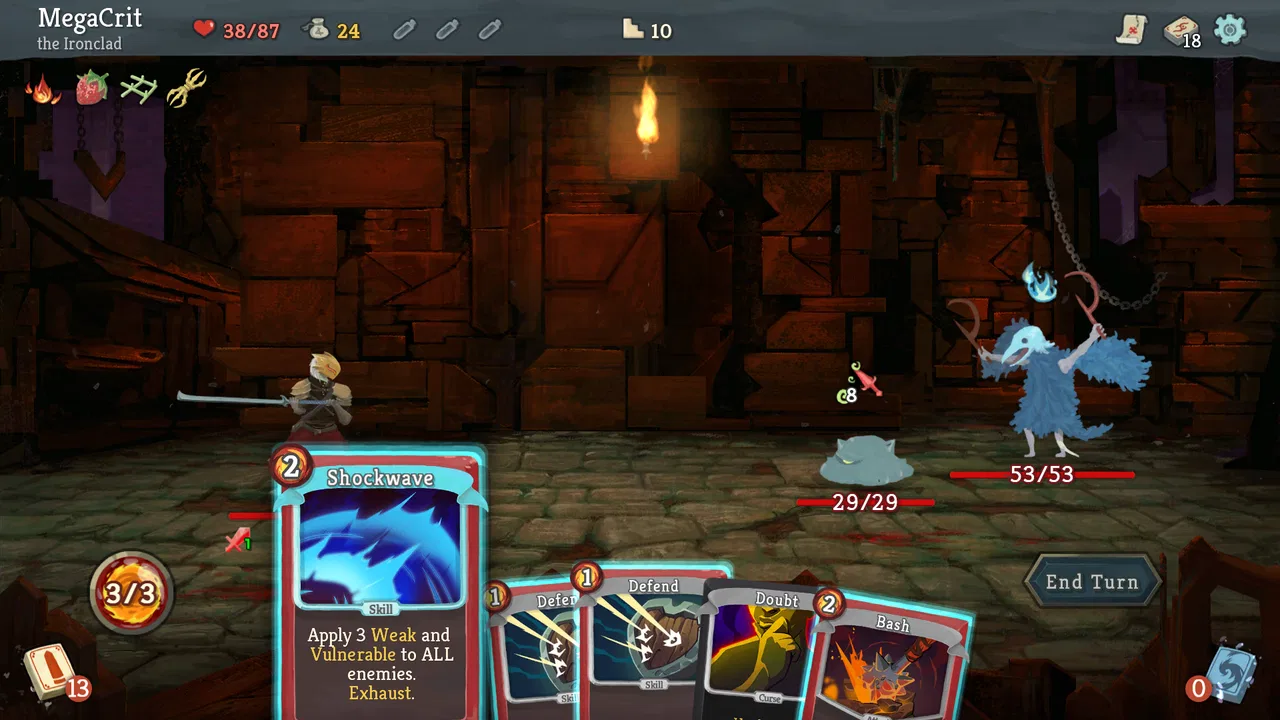
Combat becomes much easier once I stop thinking only about the damage I can deal this turn. Enemy intentions give me a reason to plan ahead. If an opponent is preparing a heavy attack, a defensive turn may be more important than squeezing in a little extra damage. If the next turn looks harmless, I can use that window to set up a stronger position rather than spending everything immediately.
This also explains why the game can feel unfair during a first session. A poor hand can make a battle look lost, but many encounters are designed around managing imperfect draws. I try to preserve flexible cards, avoid spending every resource on one dramatic turn, and remember that a modest improvement repeated over several turns is often safer than a flashy play with no follow-up.
There is a useful distinction between a card that is powerful and a card that is reliable in my current deck. A high-impact card may be excellent when the deck can support it, yet clumsy when it arrives without the right setup. Early in a run, I value cards that solve common problems immediately: consistent defense, efficient attacks, or effects that improve future turns without demanding a complicated chain.
The game also rewards learning from failure rather than trying to repeat a perfect sequence. When a run ends, I can usually identify a decision that deserves another look: perhaps I took an elite encounter while already low on health, upgraded a card that did not fit the plan, or ignored defense because the deck was dealing impressive damage. That review process gives the game much more staying power than a simple win-or-lose loop.
Setup checks before blaming the game
Because this is a premium mobile release, my first practical check would be the basics: confirm that the device meets the Android 5.1 minimum, make sure the installation has completed properly, and leave enough free storage for the operating system to finish its work. These are simple steps, but they prevent a surprising amount of confusion when a game does not open cleanly or behaves differently after an update.
I would also restart the device before trying more involved fixes. If the game has just been installed or updated, a fresh launch can clear a temporary problem that looks like a fault in the app itself. On Android, checking for a pending system update is sensible too, especially on older hardware. The game supports an older Android baseline, but support for an operating system does not guarantee identical performance on every device.
Touch controls deserve a quick check before judging the gameplay. Card games depend on accurate selection, and a screen protector, a dirty display, or an unusual touch-response setting can make a perfectly good card feel unresponsive. I test several buttons and cards rather than assuming the entire game is broken. If only one area is difficult to press, the cause may be the device or the screen rather than the software.
For a paid game, I also recommend confirming that the store account used for installation is the account that owns the purchase. If the game is being restored on another device, account confusion can look like a payment problem even when the transaction is fine. I would avoid repeatedly purchasing anything while trying to diagnose access; first verify the account, installation status, and device compatibility.
Version awareness matters as well. The current version is 2.6.1, so I would check that the installed build matches the latest version available for the device. If an update is offered, I would install it before testing a problem repeatedly. Afterward, I would launch the game once with other demanding apps closed, since limited memory can affect startup on older phones and tablets.
Recovering a run without making the problem worse
When a run feels broken, my first response is not to restart immediately. I examine what the deck is actually failing to do. If I am losing because damage is too slow, adding more random attacks may make the deck less consistent. If I am taking too much damage, another offensive card may be the wrong answer. I look for the narrowest correction: better defense, improved card access, or a way to make the existing plan arrive more often.
One practical recovery method is to slow down at the map screen. I choose a path that gives the deck time to stabilize instead of forcing another high-risk fight. This is especially useful after a poor battle leaves the character with low health. A safer route may appear less rewarding, but surviving long enough to reach a useful upgrade or recovery point can be worth more than gambling on an elite encounter.
I also avoid changing the whole strategy after one bad draw. Card games naturally produce unlucky turns, and overreacting can make the deck incoherent. I ask whether the problem appeared repeatedly or only once. If the same weakness shows up across several fights, it deserves attention. If it happened in one unusually awkward hand, the better response may be to preserve the plan and play more conservatively next time.
For beginners, I find it helpful to treat each character as a separate language. A card that feels excellent in one style may be mediocre in another because its value depends on the surrounding deck. I spend a few runs learning the basic rhythm of one character before switching constantly. That makes losses more informative and helps me understand whether a new card is genuinely useful or merely familiar-looking.
There is also a subtle workflow lesson in how I spend upgrades and other limited opportunities. I prioritize cards that appear frequently and improve ordinary turns, not only cards that look impressive in a theoretical perfect hand. A small improvement to a card I draw often can shape an entire run. By contrast, investing heavily in a rare card that depends on several other pieces may leave the deck fragile if those pieces never arrive together.
If a run becomes confusing after putting the game down for a while, I take a moment to inspect the deck and map before acting. Returning in a hurry can lead to an unnecessary battle or a poor route choice. This is one reason the game works well in short sessions: I can pause between decisions instead of feeling forced to complete everything in one sitting.
When the phone, account, or environment is the real issue
Not every unpleasant experience points to a gameplay flaw. If the game closes during startup, I distinguish between a repeatable crash at the same point and a one-time failure after multitasking. The former deserves careful troubleshooting; the latter may be a temporary memory issue. Restarting, closing background apps, and checking the installed version are reasonable first steps before reinstalling anything.
Reinstallation should be a last resort rather than an automatic fix. Before using it, I make sure I understand what may happen to local progress and confirm that I can access the same store account afterward. I would not erase app data casually, because removing local information can create a bigger problem than the original launch issue. The safest approach is to try less destructive steps first and record anything important about the current state.
Performance can also be mistaken for poor design. Older devices may struggle more when they are hot, nearly full, or running many background processes. If the game feels sluggish only after a long mobile session, I test it again after cooling the device and closing other apps. If the same problem appears consistently on a supported device, then it is fair to consider whether the hardware is simply not a comfortable match.
For people deciding between this and a free card game, the price changes the expectations. The $9.99 purchase makes more sense to me when I want a focused single-player experience with meaningful decisions and replay value. It is less suitable if I am looking for social matches, a constantly changing collection, or a game designed for a few seconds of casual play. A free alternative may be better for someone who wants to sample the genre without paying upfront, even if its structure is less focused.
Compared with traditional digital card games, this one is less about building a permanent collection and more about adapting during each run. That makes it easier to start without studying a large competitive environment, but it also means that players who prefer direct competition or long-term deck ownership may miss those elements. I enjoy the self-contained structure because each attempt feels like a puzzle rather than a test of how much content I have accumulated.
Who will enjoy it, and who should skip it
I would recommend it to someone who likes turn-based strategy, roguelike repetition, and card games where restraint matters. It is particularly good for players who enjoy asking why a run failed and changing one decision on the next attempt. The game can fit into a commute or an evening at home, but its best sessions are the ones where I have enough attention to think through a route and not just tap the most obvious card.
I would be more cautious recommending it to someone who dislikes losing progress, dislikes reading enemy intent, or wants immediate power growth. The game expects experimentation, and a successful run often comes after several unsuccessful ones. It also asks the player to accept that a sensible decision can still lead to an awkward outcome. That uncertainty is part of the appeal, but it can feel frustrating if I want a predictable progression system.
A realistic everyday use case is a short break in which I play until the next major decision, then stop. I can close the game after choosing a route or finishing a battle and return later with a clear point to continue. On a longer evening, I may use a run as a focused alternative to scrolling because the game keeps my attention on a chain of small choices rather than flooding me with unrelated tasks.
The main trade-off is that the game becomes more enjoyable as I learn it, but that learning curve can make the first hours feel less welcoming than the store summary suggests. I would not judge it solely on the first failed attempt. At the same time, I would not tell every player to push through indefinitely. If the central loop of building, testing, and losing does not become interesting after a few tries, more practice may not change the basic fit.
My practical verdict
Slay the Spire is worth choosing when you want a serious card strategy game rather than a lightweight time filler. Balor Games has built an experience where the most important move is often the one I decline to make: skipping a card, avoiding a dangerous route, or saving resources for a less dramatic turn. Those decisions give the game its personality and make each run feel personal.
The current version, 2.6.1, supports Android devices running version 5.1 or later, and the broad install base suggests it is not a niche experiment. Still, I would check the age rating, device condition, and purchase account before downloading, especially if I am moving between phones. Those small setup checks reduce the chance of mistaking an installation or hardware problem for a defect in the game.
My strongest advice is to keep the first few runs simple. Do not chase every reward, do not force a complicated combination, and do not treat a loss as wasted time. Use each attempt to identify one weakness in the deck and correct that weakness on the next route. Once that habit clicks, the game stops feeling like a pile of random cards and starts feeling like a series of decisions I can genuinely improve.
For me, the $9.99 price is justified by the depth of that loop, provided I want a solo strategy experience and am comfortable with repeated failure. Players seeking multiplayer competition, instant gratification, or a free trial should look elsewhere. Everyone else will find a thoughtful, demanding card game that rewards patience, careful setup, and the willingness to leave a good-looking card behind when it does not belong.
FAQs for Slay the Spire
01What is Slay the Spire, and how does the gameplay work?
Slay the Spire is a single-player deck-building roguelike in which you climb a constantly changing tower filled with enemies, events, merchants, and elite encounters. Before each run, you choose a character with a unique card pool and abilities. During battles, you build a deck while making strategic decisions about attacks, defense, powers, relics, and the route you take through the Spire.
02Is Slay the Spire difficult for new players?
The game is easy to understand but challenging to master. Early battles teach the basic systems clearly, yet successful runs require careful planning, because health, cards, potions, and relics must be managed efficiently. Losing a run is normal and useful: each attempt helps you learn enemy patterns, improve deck-building decisions, and understand which strategies work best for each character.
03Does Slay the Spire require an internet connection?
Slay the Spire is primarily an offline game, so you can play runs without a constant internet connection. This makes it suitable for travel, commuting, or playing in areas with limited service. An internet connection may still be needed for downloading the game, receiving updates, or using platform-related services, but the main single-player experience does not depend on being online.
04How much content and replay value does Slay the Spire offer?
Slay the Spire provides substantial replay value because every run changes the map layout, card rewards, relics, events, and enemy encounters. Each playable character encourages a different approach, and higher Ascension levels add increasingly demanding challenges after you progress. Daily challenges and unlockable content further extend the experience, making it a strong choice for players who enjoy repeated strategic runs.
05Does Slay the Spire include in-app purchases or ads on mobile?
The mobile version is generally presented as a premium game rather than a free-to-play title, meaning you typically purchase it once instead of dealing with energy systems, intrusive advertising, or frequent microtransactions. Store listings and pricing can vary by platform, region, and promotion, so it is worth checking the current Google Play or App Store page before downloading.
Pros
- Deep deck-building system with many viable strategies
- Runs feel different thanks to varied enemies
- relics
- and events
- Clear turn-based combat is easy to learn but hard to master
- Excellent replay value through Ascension levels and daily challenges
- Works well in short sessions without requiring an internet connection
Cons
- Random card and relic rewards can sometimes make runs feel unfair
- Higher Ascension levels may be too punishing for casual players
- Limited story and character interaction outside the core gameplay
- Some powerful strategies take time to understand and optimize
- The interface can feel cramped on smaller phone screens

Slay the Spire
Gallery